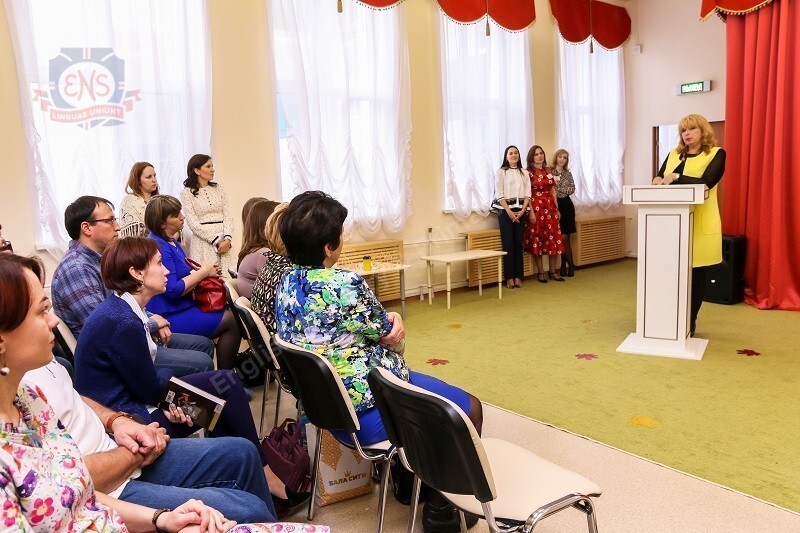
On October 27–28, 2017, Kazan hosted the Republic-level Scientific and Practical Conference “Children’s Intellectual Development: Kindergarten to Primary School,” held to mark the first anniversary of the multilingual kindergarten Bala-City.
The conference sessions focused on criteria for assessing the quality of the early childhood learning environment, as well as technologies for children’s intellectual development (mathematics, logic, robotics). Participants also discussed practical experience with TRIZ-based pedagogy, STEAM approaches, and other methods. Special attention was given to the impact of bi- and multilingual environments on child development.
ENS Director Anna-Maria Nikolaeva delivered a presentation titled “A Bilingual Model for Organising the Educational Environment at English Nursery and Primary School.” In her talk, she drew the attention of both researchers and early childhood practitioners to the specific features of a bilingual learning environment and its key components (programmes, teaching methods, staff, etc.). The foundation of early child development through foreign languages is the immersion method—learning in a rich language environment. The presentation noted that the core principles of this approach include: providing a language environment, separating languages, and using language functionally.
Language immersion makes it possible to take into account children’s cognitive and psychological characteristics (activity and engagement), motivate children to speak and explore, and develop all functional aspects of language (cognitive, communicative, interactive, ethnocultural, and personal).
The approach used at ENS to design a bilingual developmental learning environment not only helps children build a strong level of bilingualism, but also has a positive impact on their overall development.
The conference sessions focused on criteria for assessing the quality of the early childhood learning environment, as well as technologies for children’s intellectual development (mathematics, logic, robotics). Participants also discussed practical experience with TRIZ-based pedagogy, STEAM approaches, and other methods. Special attention was given to the impact of bi- and multilingual environments on child development.
ENS Director Anna-Maria Nikolaeva delivered a presentation titled “A Bilingual Model for Organising the Educational Environment at English Nursery and Primary School.” In her talk, she drew the attention of both researchers and early childhood practitioners to the specific features of a bilingual learning environment and its key components (programmes, teaching methods, staff, etc.). The foundation of early child development through foreign languages is the immersion method—learning in a rich language environment. The presentation noted that the core principles of this approach include: providing a language environment, separating languages, and using language functionally.
Language immersion makes it possible to take into account children’s cognitive and psychological characteristics (activity and engagement), motivate children to speak and explore, and develop all functional aspects of language (cognitive, communicative, interactive, ethnocultural, and personal).
The approach used at ENS to design a bilingual developmental learning environment not only helps children build a strong level of bilingualism, but also has a positive impact on their overall development.